


IASR 47(8), 2026【THE TOPIC OF THIS MONTH】Malaria, Japan, 2007-2025
PDF download(PDF:465KB)
The Topic of This Month Vol.47 No.8 (No. 558)
Malaria, Japan, 2007-2025
(IASR Vol. 47 p139-141: August 2026)
Malaria is one of the three major infectious diseases prevalent worldwide, together with acquired immunodeficiency syndrome (AIDS) and tuberculosis, and is widely endemic, particularly in tropical and subtropical regions around the equator. Especially since the coronavirus disease 2019 (COVID-19) pandemic, both the number of malaria cases and deaths have increased, and according to the latest information published by the World Health Organization (WHO), it was reported that there were approximately 280 million incident cases and approximately 610,000 deaths in 2024 (World malaria report 2025: https://www.who.int/publications/i/item/9789240117822). Regarding global malaria trends, approximately 95% of deaths are concentrated in sub-Saharan Africa; however, attention is also required in Asian countries such as Thailand, Myanmar, and the Republic of Korea, where the number of infected persons has increased in recent years.
Malaria is a parasitic disease caused by infection with a malaria parasite and is transmitted by Anopheles mosquitoes. In humans, fever, anemia, and splenomegaly are known as the three major signs of malaria. Additionally, patients may present with diverse symptoms such as chills, headache, arthralgia, diarrhea, and jaundice, and multiple laboratory abnormalities including thrombocytopenia and liver dysfunction are frequently observed. In particular, severe malaria can cause conditions including severe encephalopathy, acute renal failure, disseminated intravascular coagulation (DIC), pulmonary edema, and can therefore be fatal if appropriate treatment is delayed.
Malaria parasites first undergo the liver stage, during which they multiply within hepatocytes in the human body, before entering the bloodstream and progressing to the blood stage, during which they multiply within erythrocytes and cause clinical symptoms. Furthermore, some parasites differentiate into gametocytes, and when ingested by an Anopheles mosquito during a blood feeding, meiosis associated with sexual reproduction takes place, producing the next generation of parasites and enabling transmission to another human host. Malaria parasites are unicellular eukaryotes that undergo genetic recombination associated with meiosis, and because their modes of proliferation and metabolic pathways differ substantially between the liver and blood stages, they readily acquire immune evasion mechanisms and drug resistance, making their control extremely challenging.
Human malaria is classified by combining the disease name and causative parasite as follows: (1) falciparum malaria: Plasmodium falciparum; (2) vivax malaria: P. vivax; (3) quartan malaria: P. malariae; and (4) ovale malaria: P. ovale, with these four species accounting for nearly all cases notified in Japan. In endemic areas, however, zoonotic simian malaria is increasing, and (5) knowlesi malaria: P. knowlesi, which was previously considered a simian malaria, has now been assigned a Japanese disease name and is a major parasite species prevalent in Malaysia. In addition, (6) simian malaria: several simian malaria parasite species, including P. cynomolgi, P. inui, and P. coatneyi, have been implicated in numerous cases of human infection.
Regarding global malaria control programs and the Global Fund, since the Roll Back Malaria (RBM) initiative, WHO has promoted activities focusing on vector control, diagnosis and treatment, surveillance, and research and development (see p.142 of this issue). In terms of financing, the Global Fund has provided support based on national programs and has contributed substantially to reducing mortality; however, financial deterioration and declining contributions have become challenges in recent years.
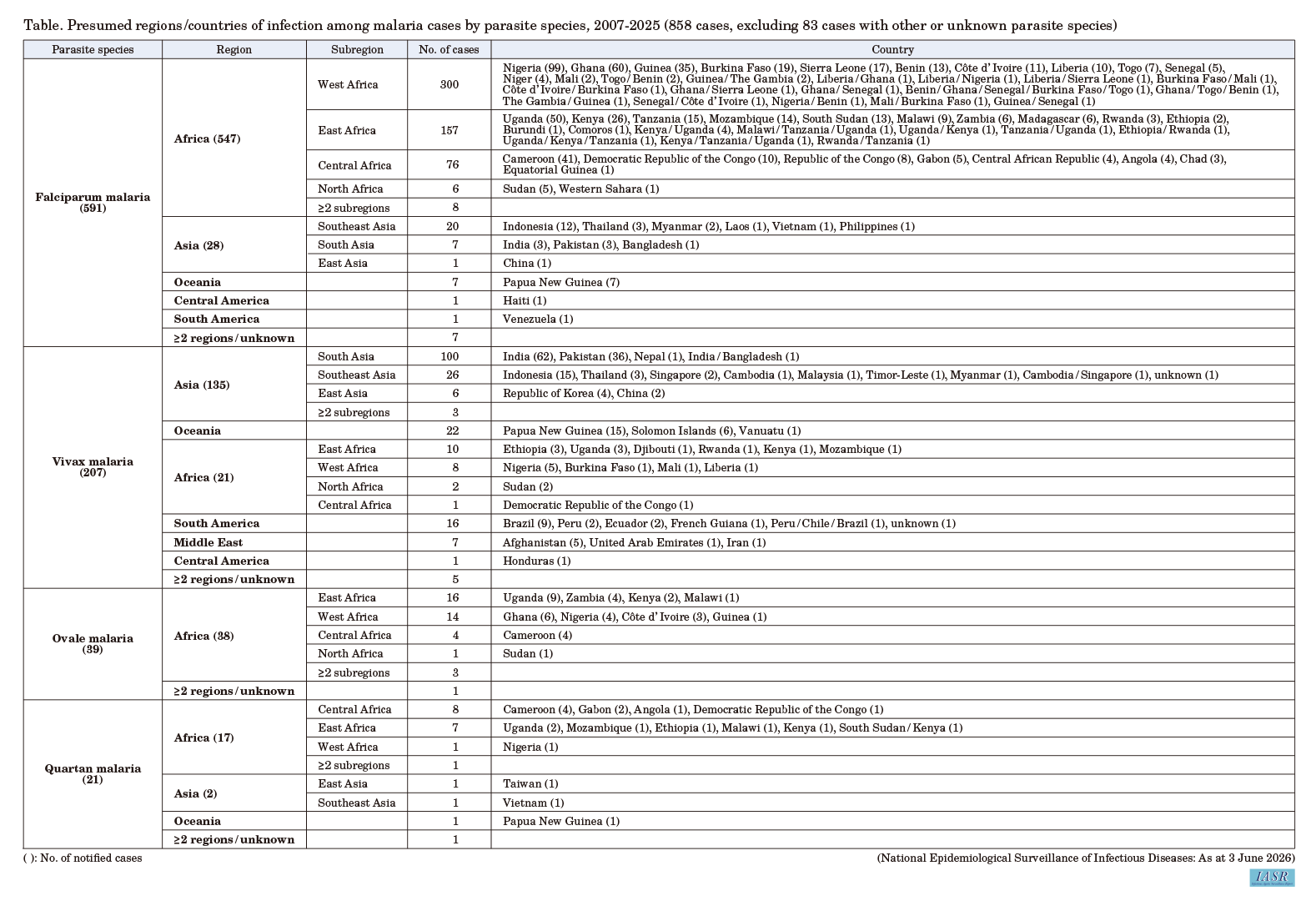
In Japan, all malaria cases are currently imported, and malaria is a Category IV Infectious Disease subject to notifiable disease surveillance under the Infectious Diseases Control Law (notification criteria: https://www.mhlw.go.jp/bunya/kenkou/kekkaku-kansenshou11/01-04-33.html). The annual number of notified cases exceeded 100 in the early 2000s, but declined to 21 in 2020 due to the impact of travel restrictions associated with the COVID-19 pandemic. The number subsequently increased again, and has remained at approximately 50 cases annually in recent years (see p.143 of this issue). Notification data for 2007-2025 (Fig. and Table on p.141) show clear differences in regions of origin by parasite species. Of the notified cases, 93.7% of falciparum malaria, 100% of ovale malaria, and 85.0% of malariae malaria originated in Africa; 66.8% of vivax malaria cases originated in Asia. Among all imported cases, Africa accounted for the largest proportion at 71.8%, followed by Asia at 21.6%. Oceania (3.6%) and South America (2.1%) accounted for only small proportions, indicating that imported malaria in Japan occurs primarily in association with travel to and return from Africa and Asia.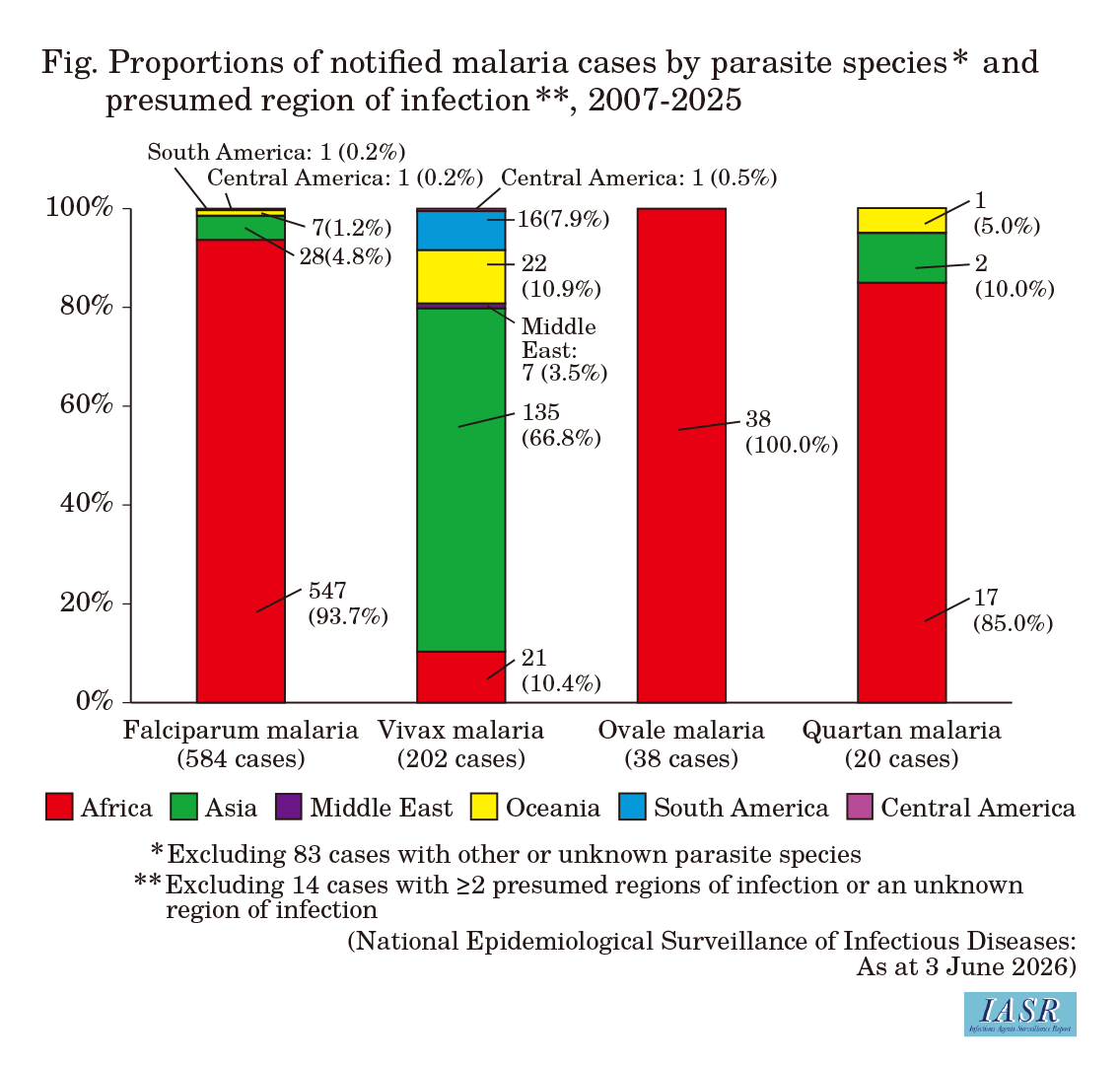
More than 500 species of Anopheles mosquitoes exist worldwide, of which approximately 100 species transmit the malaria parasite and approximately 40 are considered major vectors. Major vector species differ by region; in Southeast Asia, with urbanization, the forest-dwelling An. dirus has become an important species in place of An. minimus, and these mosquitoes transmit not only human malaria parasites but also multiple simian malaria parasites (see p.144 of this issue). In Africa, An. gambiae and other species are major vectors, with substantial regional differences in ecology and blood-feeding behavior (see p.146 of this issue). In recent years, An. stephensi, which originated in the Middle East and Asia, has invaded Africa, and control measures are required because of its high vectorial capacity.
Meanwhile, insecticide resistance has become increasingly serious, and although indoor residual spraying (IRS) and long-lasting insecticidal nets (LLINs) have contributed substantially to vector control, pyrethroid resistance has spread among many species, including An. gambiae and An. funestus (see p.147 of this issue). Insecticide resistance arises through target-site mutations and enhanced metabolic enzyme activity, and has been widely documented in various regions; therefore, in addition to insecticide rotation and the introduction of new LLINs, continuous resistance monitoring and the development of new technologies are essential.
Antimalarial drugs currently available in Japan include Riamet, Malarone, Mephaquin, and Primaquine, and for prophylaxis in travelers, Mefloquine and Malarone are mainly used (see p.148 of this issue). Meanwhile, partial resistance to artemisinin-based combination therapy (ACT), the global standard treatment, is spreading. As a countermeasure, the triple artemisinin-based combination therapy (TACT) has been developed, and ALAQ, which combines artemether and lumefantrine (AL) with amodiaquine (AQ), is currently undergoing a phase III clinical trial. The novel drug Ganaplacide-Lumefantrine is also expected to have high therapeutic eff icacy; however, given the emergence of drug resistance, continuous development of new drugs is essential. Drug-resistant malaria is a serious problem, with artemisinin resistance associated with PfK13 mutations spreading from Southeast Asia to Africa, and resistance to partner drugs has also been reported (see p.149 of this issue). Because the mechanisms of drug resistance involve interactions among multiple genes, genomic surveillance has become increasingly important, and monitoring systems integrating large-scale genomic data with molecular marker analyses need to be established and strengthened. Although WHO recommends ACTs for malaria treatment in endemic countries, gaps exist at each stage of diagnosis, prescription, and medication in actual practice, with some patients remaining untreated despite positive test results and others receiving empirical treatment despite negative results (see p.150 of this issue). Rapid diagnostic tests (RDTs) have limitations, including false-negative results and inability to detect asymptomatic parasitemia, and the development of new diagnostic technologies with higher sensitivity and reliability is required.
Regarding malaria vaccines, two vaccines, RTS, S/AS01 and R21/Matrix-M, have been introduced into practical use. Although these vaccines reduce the risk of developing malaria and severe disease in children, challenges remain in infection prevention, eff icacy duration, and supply systems (see p.152 of this issue). To complement these vaccines, next-generation vaccines are under development, with particular attention being given to multi-target, multi-stage vaccines and mRNA vaccines. Nagasaki University and Shionogi & Co., Ltd. are developing an mRNA vaccine that acts during the hepatic stage and induces tissue-resident memory T cells (TRM).
With the increasing emergence of simian malaria as a zoonotic disease in recent years, human infections with P. knowlesi originating from wild monkeys have increased in Southeast Asia, and severe cases have also been reported (see p.153 of this issue). Furthermore, numerous human infections with other simian malaria parasites, including P. cynomolgi and P. inui, have been identified, and molecular epidemiological investigations will be required to elucidate the mechanisms underlying establishment and transmission of infection and to inform monitoring and control.
Understanding the mechanisms by which infection with these parasites is established requires knowledge of their genomic structures and phylogenetic evolution. Comparative analyses of parasite species contribute to understanding host specificity and antigenic diversity, while the accumulation of genomic information provides a foundation for drug and vaccine development (see p.154 of this issue).
Conclusion
All malaria cases in Japan are currently imported; however, because vector mosquitoes remain widely distributed throughout Japan, rapid identification of infected patients is extremely important. In addition, “airport malaria,” in which infected mosquitoes are introduced by aircraft or other means, has become a problem in Europe, and similar cases have been reported in Japan in the past. Therefore, vector mosquito surveillance is extremely important as a border control measure. Accordingly, the Quarantine Act requires regular collection of mosquitoes and rodents as well as pathogen testing and control in preparation for these risks and other vector-borne infectious diseases.
Malaria remains an extremely important infectious disease, and although advances have been made in diagnosis, treatment, vaccines, vector control, and surveillance, challenges include the spread of drug-resistant parasites, insecticide-resistant mosquitoes, and simian malaria. Genomic analyses of malaria parasites promote the development of new diagnostics, drugs, and vaccines, and strengthening international collaborative research frameworks is extremely important from the perspective of infection control. Going forward, the implementation of evidence-based measures must be continued, and effective control strategies linking basic research with practice in the field will be required.