


IASR 47(9), 2026【THE TOPIC OF THIS MONTH】Invasive meningococcal disease in Japan, April 2013-April 2026
PDF download(PDF:447KB)
The Topic of This Month Vol.47 No.9 (No. 559)
Invasive meningococcal disease in Japan, April 2013-April 2026
(IASR Vol. 47 p161-162: September 2026)
Invasive meningococcal disease (IMD) is an infectious disease caused by the Gram-negative diplococcus Neisseria meningitidis, which can cause severe symptoms such as meningitis, bacteremia, sepsis. Meningococci are classified into 12 serogroups based on differences in the polysaccharide capsule, of which serogroups A, B, C, X, Y, and W are the main causes of IMD. On the other hand, meningococci are also isolated from the nasopharynx of healthy individuals at a frequency of less than 1% in Japan, indicating the presence of so-called “ healthy carriers.” Transmission occurs through droplets produced by coughing and sneezing. The risk of transmission is increased by living in the same household, as well as close contact such as sharing drinks and kissing. In addition, persons with immunodeficiencies, including complement deficiency or reduced complement function, asplenia (including splenic dysfunction), and human immunodeficiency virus (HIV) infection, are considered to be at high risk for developing IMD.
IMD has been designated as a Category V Infectious Disease subject to notifiable disease surveillance under the Infectious Diseases Control Law since April 1, 2013. Since November 2016, cases in which the pathogen is detected not only from blood or cerebrospinal fluid but also from “other normally sterile specimens, such as synovial fluid” have also been subject to notification. Physicians who diagnose IMD are required to notify the case “ immediately” after diagnosis, including the patient’s name and address (IASR 39: 1-2, 2018) (notification criteria: https://www.mhlw.go.jp/bunya/kenkou/kekkaku-kansenshou11/01-05-09-01.html). When mass spectrometry is used for bacterial species identification, confirmation by additional testing is important because of the possibility of misidentification (see p.166 of this issue).
IMD is a severe disease, with a case fatality rate of 10-15% even when appropriate treatment is provided. The incubation period is an average of 4 days (range: 2-10 days), and nonspecific symptoms such as fever and headache may occur during the early stage of illness; however, the disease may rapidly become severe and lead to death or sequelae (see p.167 of this issue).
Ceftriaxone and cefotaxime are mainly used for treatment, and if the isolate is confirmed to be susceptible to penicillin G, treatment may be changed to penicillin G or ampicillin. Antimicrobial susceptibility analysis of isolates obtained in Japan confirmed good susceptibility to ceftriaxone, whereas many isolates were nonsusceptible to penicillin G, including resistant isolates (see p.164 of this issue).
National Epidemiological Surveillance of Infectious Diseases: A total of 464 cases were notified from April 2013 through April 2026 (Fig. 1). Approximately 20-40 cases were notified annually from 2013 through 2019, whereas during the coronavirus disease 2019 (COVID-19) pandemic period from 2020 through 2022, the annual number decreased to 1-13 cases. The number returned to the pre-COVID-19 pandemic level with 21 cases in 2023 and subsequently increased to 68 cases in 2024 and 84 cases in 2025. The number of notified cases in 2025 was the highest since IMD became a Category V Infectious Disease subject to notifiable disease surveillance in 2013. In addition, 22 cases were notified from January through April 2026, the second highest number for the same period in the previous years, after 2025.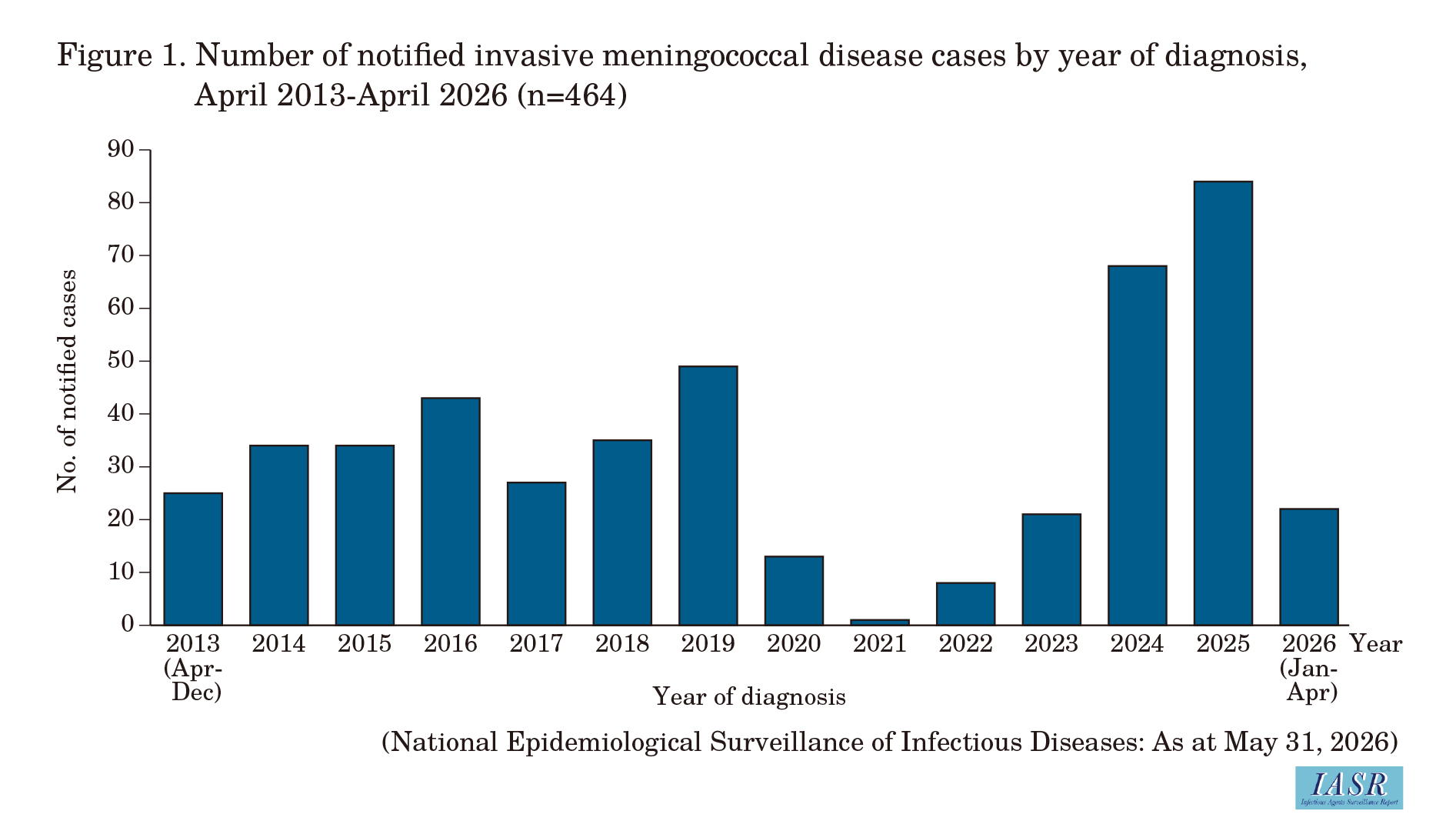
By prefecture, the largest numbers of cases were notified, in descending order, from Tokyo, Osaka, Aichi, Hyogo, and Kanagawa, and these five prefectures accounted for 51% of all cases. Based on the 2019 population, the number of notified cases per 100,000 population was highest in Okinawa Prefecture (1.17), followed by Wakayama Prefecture (0.86) and Osaka Prefecture (0.62).
With regard to sex, males accounted for 55% (254 cases) of the notified cases. By age group, the largest number of cases was reported among persons aged ≥70 years, and those aged ≥50 years accounted for 58% (271 cases) (Fig. 2). 86% (401 cases) were presumed to be infected within Japan. At the time of notification, 8.6% (40/464) of cases were reported as fatal, and fatal cases at the time of notification were also reported among patients in their 20s and younger age groups.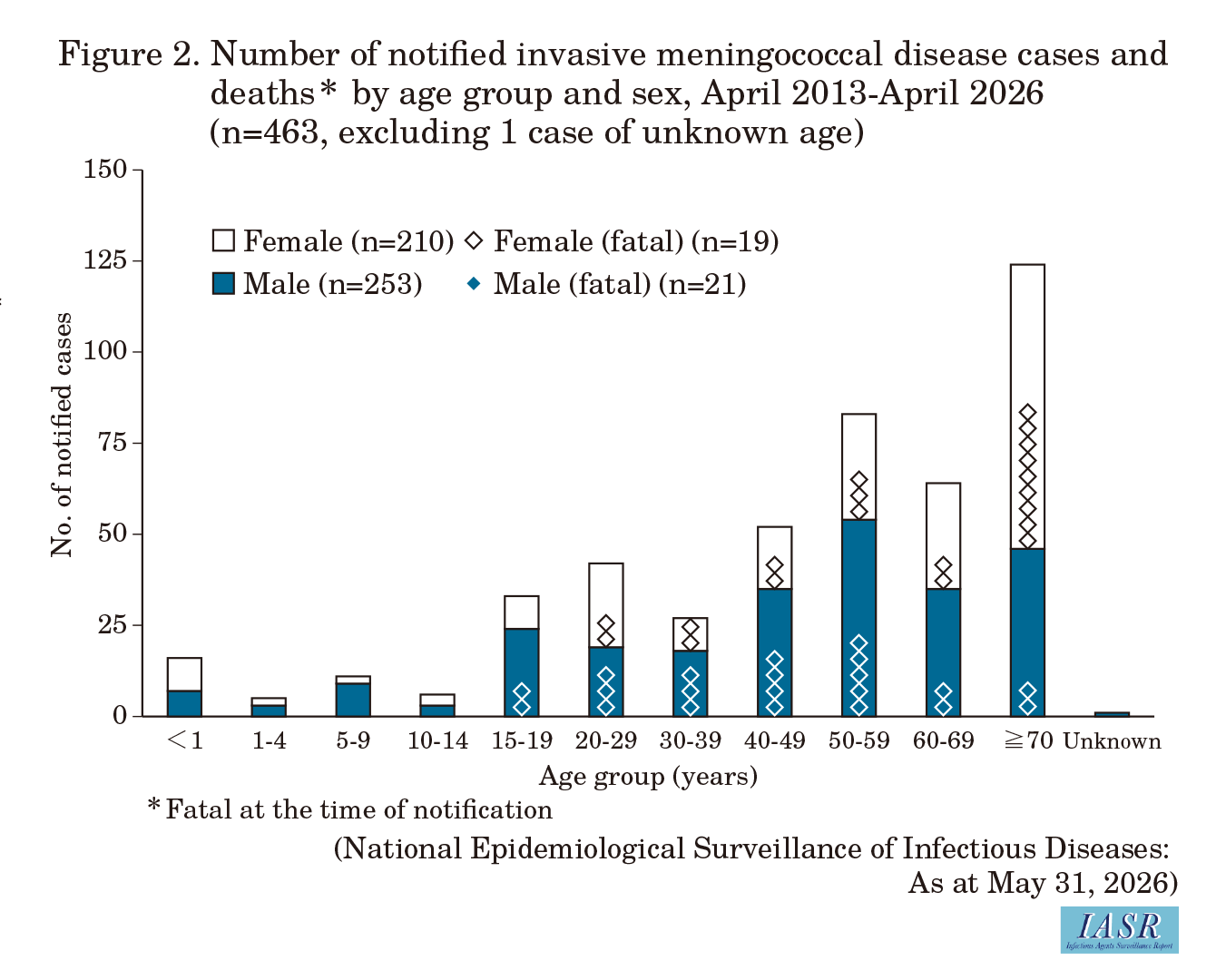
Serogroup distribution of notified cases and molecular epidemiological analysis: Among the 464 cases notified from April 2013 through April 2026, information on serogroup was reported for 211 cases (45%) (Fig. 3); serogroup Y was the most common, with 114 cases, followed by serogroup B with 46 cases, serogroup W with 19 cases, and serogroup C with 10 cases. In addition, 16 cases could not be differentiated between serogroups Y and W, and 6 cases were non-groupable.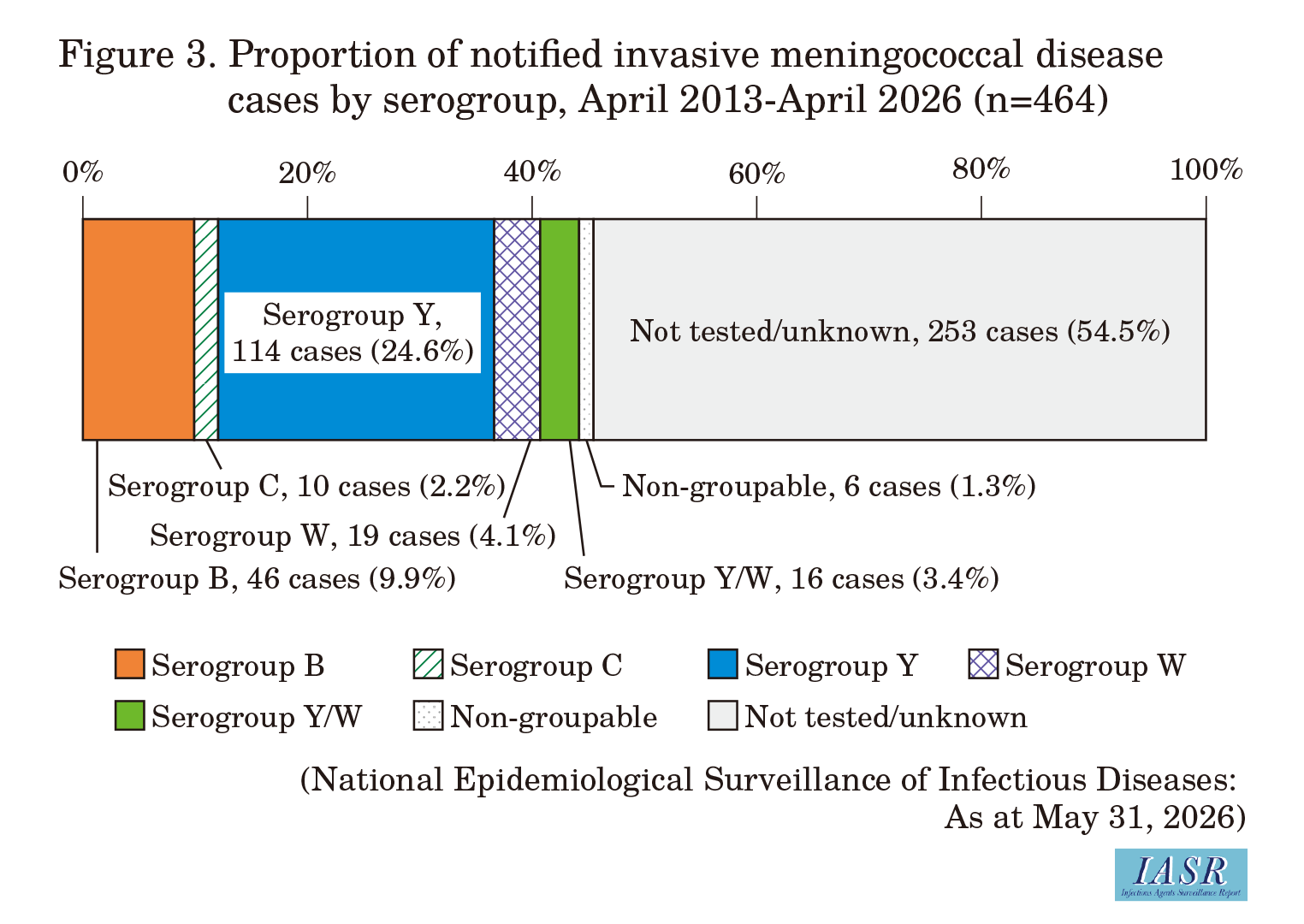
The Department of Bacteriology I, National Institute of Infectious Diseases (NIID), Japan Institute for Health Security (JIHS), conducts genetic analysis of sequence types (STs) using multilocus sequence typing (MLST), and performs molecular epidemiological analysis through comparison with an international database. A total of 97 isolates were collected from 2018 through 2023. Among previously isolated strains in Japan, ST-23 of serogroup Y had been predominant (IASR 39: 3-4, 2018). However, in the present analysis, ST-1655, belonging to clonal complex (cc) 23, was mainly detected among serogroup Y isolates, while ST-2057, a strain unique to Japan, was mainly detected among serogroup B isolates. Isolation of ST-11, which is considered to have higher invasiveness than other strains, was limited. As at 2023, no marked increase was observed in strains presumed to have been introduced from overseas (see p.163 of this issue).
Prevention of transmission following case occurrence and prevention by vaccination: When an IMD case occurs, as well as prompt treatment of the patient, prevention of further transmission is important. Contacts during the patient’s infectious period should be promptly identified, and antimicrobial post-exposure prophylaxis should be administered as early as possible to close contacts and persons at high risk. Rifampicin or ciprofloxacin can be used orally for prophylaxis, and intramuscular ceftriaxone is also an option. However, among isolates obtained in Japan, ciprofloxacin-nonsusceptible strains have been disproportionately identified in certain genotypes, including ST-2057 (see p.164 of this issue); therefore, attention should be paid to antimicrobial selection when prophylaxis is prescribed before analysis of the causative strain. Azithromycin may also be an option when ciprofloxacin resistance is a concern.
Vaccination is also an option for medium- to long-term prevention. In Japan, a quadrivalent meningococcal vaccine targeting serogroups A, C, W, and Y (tetanus toxoid conjugate vaccine) is available, whereas vaccines targeting serogroup B have not been approved in Japan. Internationally, however, pentavalent meningococcal vaccines have been approved and introduced, including MenABCWY vaccines containing serogroup B and MenACWYX conjugate vaccines containing serogroup X (see p.173 of this issue).
Epidemiological situation overseas: Similar to Japan, multiple countries overseas experienced decreases in the number of IMD cases during the COVID-19 pandemic in 2020-2021, followed by subsequent increases (see p.170 of this issue). The serogroup distribution after the resurgence differs by country and region; in the United States, a marked increase in serogroup Y and an increase in antimicrobial-resistant strains have become public health concerns. In the “ meningitis belt ” of sub-Saharan Africa, periodic epidemics continue. Meanwhile, outbreaks associated with students and young adults have been reported in Europe and North America (see p.172 of this issue), and cases with a history of communal living, such as in student dormitories, have also occurred sporadically in Japan (see p.168 of this issue). In addition, international mass gathering events require particular attention to the risk of outbreaks, because they bring together diverse participants from regions with different carriage rates and circulating strains. Overseas, cases associated with events such as Islamic pilgrimages have been reported, and mass gathering-associated cases have also been reported in Japan in the past (IASR 36: 178-179, 2015).
In Japan, the number of notified IMD cases has increased since 2024, while opportunities to hold international mass gathering events have also become more frequent. In light of these circumstances, NIID updated the Guidelines for response to invasive meningococcal disease, 2nd edition (see p.175 of this issue). For a public health response to an IMD case, determining the serogroup, genotype, and antimicrobial susceptibility through strain analysis is important, and strengthening collaboration among medical institutions, public health centers, public health institutes, and NIID is needed.